When do I Hire an Employee Retention Consultant (and How to Choose a Good One)?
Persistent employee turnover can continue even when HR already has plenty of data. Employers may run surveys, conduct exit interviews, track resignations, and review manager feedback. The information exists, but the same departments or employee groups continue to lose people.
Why doesn’t turnover drop when you know why people quit?
Employers usually struggle to identify which signals actually matter. A “reason” is not a “driver”. A key step is to track how those signals impact various microcultures, and decide what happens next. A high turnover rate may come from poor manager relationships in one location, location or commute in another, or declining appreciation among a High Value employee group. But viewed across a whole workforce…any one of those may not seem significant.
Employee retention consulting provides a more focused way to elevate action items. A good employee retention consultant:
- Studies the employer’s own workforce
- Identifies where retention is already strong
- Isolates the population where turnover creates the greatest risk
- Connects findings to a measurable retention target,
- Priortizes the tactics with data-driven support to achieve it
A retention program that worked at another employer may not work for you. Industry, geography, labor conditions, and culture all change the result. The retention strategy should come from the employer’s own employee and employer data.
What do Employee Retention Consulting Actually Do?
Employee retention consulting focuses on why employees stay, why they quit, and what an employer can change. Any legitimate retention expert begins with a diagnostic review of the workforce rather than a predetermined set of solutions.
RETENTION VENDOR RED FLAG: Anyone who sells the “solution” before confirming the root cause of the problem.
That diagnosis may combine voluntary turnover, involuntary turnover, employee sentiment, commitment, trust, manager effectiveness, survey participation, exit feedback, tenure, location, role, and turnover intention. The value comes from understanding how these signals relate to each other.
For example, two departments can report similar turnover rates for completely different reasons. One may show falling manager trust and rising turnover intention. The other may have strong manager relationships but unusually high first-90-day attrition. The employer should not apply the same retention intervention to both.
Strong retention consulting also studies what already works. A location with consistently lower turnover may reveal local programs or HR practices that other locations can adopt. Those internal strengths can provide a practical model to replicate in other parts of the organization.
Good retention consulting establish the employer’s strengths, locate the gaps, prioritize the right employee populations, guide implementation, and measure whether voluntary turnover actually changes.
1. Why does Turnover Remain Above our Target?
A goal such as “reduce turnover” is too broad to guide a serious retention strategy. Employers first need to define the retention state they want to reach.
That means establishing the current turnover rate, relevant industry benchmark, desired retention level, target reduction, measurement period, and population in scope. The population matters because company-wide turnover can hide very different business problems.
Some employers face a High Volume retention problem. Retail associates, warehouse teams, call-center employees, and other frontline populations can create repeated recruiting and onboarding costs when turnover remains high.
Other employers face a High Value retention problem. These populations may include specialized clinicians, experienced managers, engineers, senior sales professionals, or employees with difficult-to-replace institutional knowledge.
A High Volume population and a High Value population may require different priorities, even inside the same employer. Better retention consultants identify where turnover creates the greatest operational or financial impact before recommending action.
The target reflects that distinction. A 10% drop in organization-wide turnover may mean little if the employer keeps losing its hardest-to-replace employees.
2. How do we Connect Existing HR Data to Turnover’s Root Causes?
Most employers already collect workforce data through several systems. HRIS records, applicant tracking, engagement surveys, pulse surveys, exit interviews, manager feedback, performance data, promotion history, and recognition activity can all provide useful signals.
Interpretation is harder, since employee sentiment moves with labor markets, leadership & economic conditions. A single survey score may therefore say very little without context.
Consider a trust score of 65. That number means something different if the score fell from 82 over three survey cycles. It means something else if the score improved from 50 during the same period.
The pattern matters more than the isolated number.
Longitudinal analysis tracks commitment, trust, connectedness and turnover intention. It shows whether a signal persists or fades. The same principle applies to turnover itself. A department may suddenly lose several employees after a one-time event. Another may show a steady increase in turnover intention for months before resignations rise.
A good employee retention consultant separates meaningful signals from workforce noise. Most employers already hold enough data and need a better way to connect it.
3. What if Turnover Differs by Department, Manager, Role, or Location?
Organization-wide averages can make a retention problem look smaller than it really is. An employer may report 18% voluntary turnover overall. Inside that figure, one department runs at 8% and another exceeds 30%.
The same variation can appear across locations, managers, employee roles, tenure groups, demographics, and business units. These differences matter because retention problems become easier to understand once HR segments the workforce. Two stores in the same labor market may report very different retention. Two managers may lead comparable teams but produce very different levels of Trust and Commitment. One employee group may show stable retention while another reports rising turnover intention.
Good Retention consultants compare these populations directly (and almost every other population to ensure no hidden issues). That comparison includes the employer’s strongest groups as well as the weakest. A high-retention department may reveal a manager practice that other departments can adopt.
This changes the retention strategy instantly. HR leaders can now find practices that work in strong departments and test them in weaker ones.
4. How do I give Managers Need Specific Actions for their Teams?
A retention report helps mostwhen the manager knows which action to take. Survey results may show falling commitment, weak trust, or rising turnover intention. The manager still needs to understand what caused the change AND what action should follow.
That requires more precision than a general recommendation to “improve engagement.”
Suppose turnover intention rises in one department. Exit feedback from the same group repeatedly mentions communication. While current employees report lower trust in the manager. Those signals point toward a manager-level issue that deserves direct attention.
Another department may show similar turnover intentions but strong manager trust. Employees there may report poor career advancement visibility instead. The same retention metric now points toward a different intervention.
A good retention consultant links each signal to the affected population and the right response. The recommendation names the department, location, or manager where the issue occurs. HR didn’t cause turnover. A long-term retention solution works when it includes the individuals most able to influence it.
5. How does HR establish a Defensible Retention Target?
A retention initiative begins with a baseline and end with a measurable result. CHROs and CFOs need to know whether the intervention changed the problem that justified the investment. However, HR is often dictated a result, before the size of the problem is known, and almost always before a budget is set to resolve it. Marketing doesn’t advertise without a budget. IT doesn’t upgrade without a budget. Why is HR asked to reduce a multi-million dollar turnover problem without a budget? That’s a set up to fail.
An appropriate target accounts for industry, geography, headcount, current turnover, and the population in scope An employer operating far above its industry benchmark may first aim to reach the market average. An employer already near the benchmark may focus on a narrower High Value population.
The retention target also distinguishes between total turnover and voluntary turnover. A high number of employer-initiated separations tells a different story from employees choosing to quit.
Good retention consultants define these boundaries before implementation begins. Otherwise, the employer can improve one metric while the real retention problem remains unchanged. A defensible retention target gives HR a clear measurement plan. It also creates a common number that HR, operations, and finance can evaluate together.
What is the difference between an Employee Retention Consultant vs General HR Consultant?
General HR consultants support a broad range of workforce needs. Their work may include compliance, recruiting, compensation, HR operations, workforce planning, policies, or organization design.
An employee retention consultant works within a narrower specialty. The work focuses on voluntary turnover and the signals that show why employees join, stay or quit. TThe distinction is similar to the difference between a general physician and a specialist. Both understand the wider system, but the specialist goes deeper into one defined problem.
That specialization helps most when an employer already has a capable HR function.The organization may not need another broad HR review. It may need deeper expertise in turnover prediction, workforce segmentation, retention signals, and measurable intervention.
Retention specialists should understand how turnover varies across populations. They should also link those changes to manager effectiveness, trust, and commitment.
What is the difference between Employee Retention Consulting vs Retention Software?
Retention software and employee retention consulting solve different parts of the problem. Software can collect workforce data, identify patterns, model turnover risk, and present findings to HR teams. Consulting adds interpretation, calibration, implementation guidance, and accountability.
For example, software may identify elevated turnover intentions within a regional sales team. That alert is useful, but it does not answer every question.
HR still needs to know why the signal changed and how long it has been building. HR must also confirm which employees the change affects. The employer must then choose an intervention and decide how to measure success.
A retention model needs calibration for industry, workforce composition, geography, culture, and labor conditions. A signal that matters in one workforce may carry different weight in another. Employers should ask whether they have both the technology and the retention expertise to act on the data.
What can the best Retention Consultants Measure?
Annual turnover alone tells HR what already happened. Strong retention consulting should also monitor the signals that appear before employees quit. The exact mix depends on the employer, but a retention program may track:
- Retention rate
- Voluntary turnover
- Involuntary turnover
- Commitment
- Connectedness
- Appreciation
- Loyalty intention
- Trust
- eNPS
- Manager effectiveness
- Survey completion
- Sentiment Analysis (polarity AND intensity)
- Statistical differences of responses between demographics and microcultures
- Turnover intention at 30, 60, 90, or 180 days (also known as “Attrition Risk”)
Each metric gains meaning when HR reads it alongside the others. A decline in commitment becomes more meaningful when trust falls at the same time.
Rising turnover intention matters more when exit interviews from the same group confirm the concern. Manager-level analysis can add another layer. . Under separate managers, two similar teams may report very different retention signals.
What to Ask Retention Consulting Firms
Retention consulting firms can look similar during an initial sales conversation. Buyers should focus on how each provider reaches its conclusions and how it measures success.
How long have you specialized in employee retention?
Retention expertise should extend beyond broad HR consulting. Ask how long the provider has studied voluntary turnover and employee retention specifically.
How long have you been predicting turnover?
Turnover prediction improves with historical learning. The provider should explain how long it has tested its models against real employee outcomes. .
Which industries have you worked across?
Cross-industry experience can provide useful context and stronger baselines. The consultant should still explain how it calibrates the analysis to each employer.
How do you calibrate your analysis to our organization?
The answer should address industry, geography, headcount, workforce structure, cultural norms, current turnover, and target populations. A model that arrives fully formed without employer-specific calibration deserves closer examination.
How do you identify High Volume and High Value populations?
Retention priorities should reflect business impact. The consultant should explain how workforce segmentation affects the recommended strategy.
How do you identify our retention strengths?
A strong methodology should identify high-retention populations as well as high-turnover groups. Ask how the provider finds successful internal practices and tests them elsewhere.
How do you separate signal from noise?
Workforce sentiment can change quickly. Providers should explain how they use historical trends and repeated signals before recommending intervention.
What does your success rate measure?
A success percentage needs a definition. Ask what counts as success and which engagements the provider includes. Ask which outcome it measured, and over what period.
How do you measure turnover reduction?
The provider should establish the baseline before implementation. The employer should also understand the population, measurement period, and final calculation.
What happens after the diagnosis?
Retention consulting should lead to direct prioritized action. Ask how the provider turns findings into manager actions, HR priorities, and policy changes.
Do you provide retention skills training?
Some employers need managers and internal HR teams to apply the methodology after implementation. Training can support more consistent use of retention signals across the organization.
What accountability exists if turnover does not improve?
This question separates recommendations from measurable accountability. A provider should explain how its commercial model connects to the outcome. If action is taken,do they guarantee results?
Employee Retention Consulting Evaluation Scorecard
A consistent scorecard makes retention consulting firms easier to compare.
| Evaluation Area | What to Review |
| Retention specialization | Depth of expertise in voluntary turnover |
| Years of experience | History of retention work |
| Turnover prediction | Experience modeling future turnover |
| Industry calibration | Ability to adapt analysis by industry |
| Diagnostic methodology | How root causes are identified |
| Success rate | Definition and supporting evidence |
| AI/model history | Historical testing and model maturity |
| Manager-level analysis | Ability to compare manager effects |
| Retention skills training | Support for HR and managers |
| Implementation support | Guidance after diagnosis |
| Measurement | Defined baseline and target |
| Accountability | Commercial commitment to results |
| Guarantee | Whether the contract guarantees outcomes |
The strongest employee retention vendor should be able to explain each area with specific evidence.
How do the Best Approach Employee Retention Consulting?
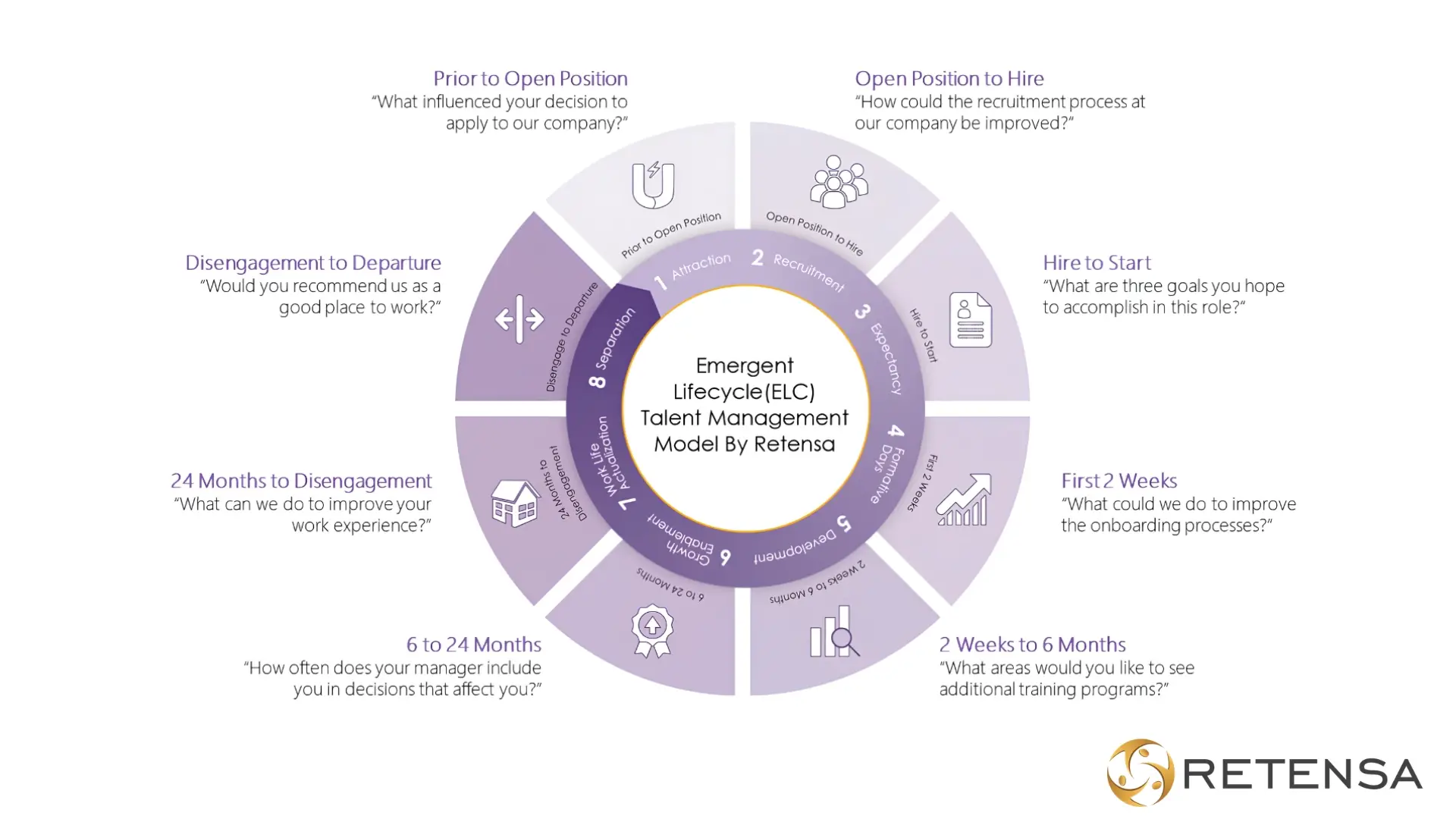
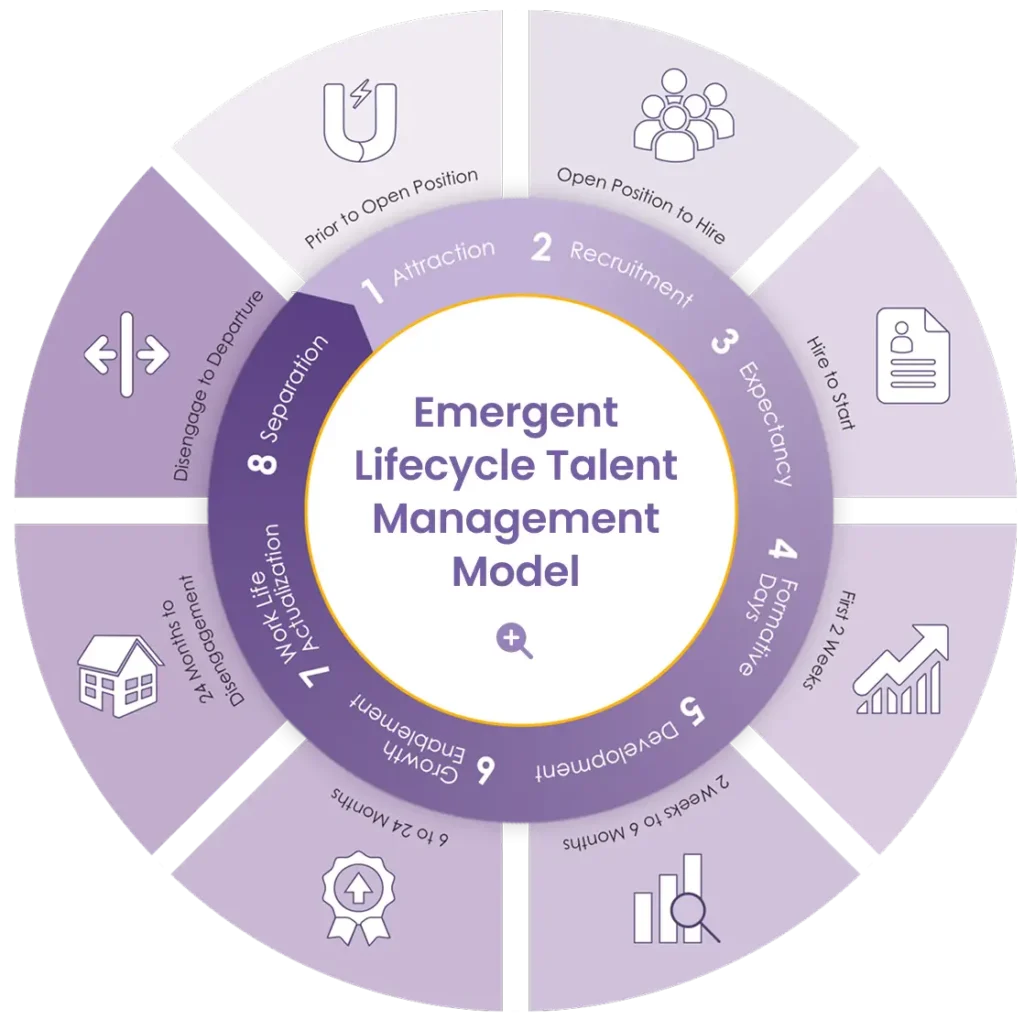
Retensa uses a full employee lifecycle approach to predict and prevent turnover. The analysis does not begin only when an employee becomes disengaged. Retensa studies workforce signals from pre-recruitment through post-separation.
TalentPulse AI measures commitment drivers across demographics, departments, roles, and other relevant workforce groups. It tracks those signals across survey cycles. Raeya AI maps sentiment polarity and intensity to traceable outcomes. This shows when employee perceptions begin to shift and how those shifts link to turnover. The process also studies the employer’s strengths.
High-retention populations can reveal working practices that deserve further analysis. Retensa then compares those findings with locations, managers, or employee groups that have higher turnover. Retensa connects the resulting data to a prescriptive retention plan. The plan reflects the employer’s industry, geography, headcount, current turnover rate, and priority populations.
That employer-specific model matters because the same retention intervention does not fit every workforce. A retailer experiencing high 60-day attrition may need a different response from a healthcare employer losing experienced nurses. A business with strong organization-wide retention may still need a focused plan for one High Value population.
Retensa reports a 98% success rate across 19 industry verticals and 25 years of retention work. Retensa backs that record with a contract-backed retention guarantee. Employers pay nothing if voluntary turnover does not decrease against the agreed target. The retention target therefore becomes more than an internal HR objective. It becomes a measurable outcome built into the engagement.
Frequently Asked Questions
When should an employer hire an employee retention consultant?
Employers should consider retention consulting when voluntary turnover stays above target despite existing HR initiatives. External expertise also helps when HR needs to find the cause inside existing data. It also suits employers whose turnover clusters in specific locations, managers, or roles.
What does an employee retention consultant do?
An employee retention consultant analyzes why employees join, stay, and eventually quit. The work can include workforce segmentation, turnover analysis, sentiment, exit data, and intervention planning. A strong consultant should also establish a measurable target before implementation.
What is the difference between employee retention consulting and general HR consulting?
General HR consulting can cover recruiting, compliance, compensation, workforce planning, organization design, and HR operations. Employee retention consulting specializes in voluntary turnover. The work focuses more deeply on retention signals, workforce segmentation, turnover prediction, and measurable reduction.
Can retention software replace an employee retention consultant?
Retention software can collect data, identify patterns, and model turnover risk. A consultant adds organizational calibration, interpretation, implementation guidance, and accountability. Employers with complex turnover patterns may need both technology and specialized retention expertise.
What data does an employee retention consultant need?
Useful information may include turnover records, employee surveys, exit interviews, tenure, role, and location. The consultant should collect only the data that answers the employer’s retention question.
What are High Volume and High Value employee populations?
High Volume populations create repeated recruiting and replacement activity because many employees move through those roles. The High Value populations may be smaller but hold specialized knowledge that takes years to replace. Retention priorities should account for the business impact of both groups.
How should employers compare retention consulting firms?
Employers should compare each firm against the scorecard above, from specialization through accountability. Buyers should also ask how each provider defines and verifies its success rate.
How long does employee retention consulting take?
Some impact can occur in as little as 3 weeks when the external retention consultant is introduced. There is a collective pause as workers are involved in, and await long-term changes. The most significant occurs between 3-6 months from start. Workforce size, available data, priority populations, and the agreed target all affect the length. A credible retention consulting firm defines the measurement approach before implementation begins.
How should employers measure retention consulting success?
Success connects to the retention problem that justified the engagement.Employers may track voluntary turnover, first-90-day attrition, or retention within a High Value population.The final measure should always connect to an agreed outcome.
Does Retensa guarantee employee retention results?
Retensa offers a contract-backed retention guarantee. Employers pay nothing if voluntary turnover does not decrease against the agreed target. The target reflects the employer’s workforce, retention baseline, and defined population.