
Employee Retention Solutions That Actually Reduce Turnover
An employee replacement now costs employers an average of $45,236, nearly $10,000 more than the year before. Half of U.S. hiring managers expect turnover to climb further in 2026.
The dollar figure understates the real opportunity. The Work Institute puts the preventable share of voluntary turnover at 75%. Gallup found that 46% of employees who quit believed their employer could have stopped it.
Preventable turnover and turnover employers actually stop rarely match. The gap between them is where employee retention solutions earn their value. HR leaders who build a structured employee retention program around real data close that gap faster. Generic perks rarely close it at all.
What Competing Research Gets Right, and Where It Stops Short
Most guides on staff retention strategies repeat the same five themes. Most guides on employee retention repeat the same themes. Recognition, for example, carries significant weight: the Achievers Workforce Institute found that employees who receive weekly recognition are nine times more likely to recommend their employer and six times more likely to see a long-term future there.
SHRM’s Work Culture Report found that culture outranks pay in retention decisions. Ninety-two per cent of employees weigh culture before deciding to stay.
These findings are accurate. The problem is that most articles stop at the list. They tell HR leaders what matters without explaining how to measure it inside their own organization. A talent retention strategy built only on industry benchmarks misses the drivers specific to one employer’s turnover pattern. Data collection targeted to that employer’s workforce closes the gap faster.
Best Employee Retention Solutions To Reduce Turnover
1. Diagnose Before You Develop a Staff Retention Plan
A staff retention plan built on assumptions usually targets the wrong problem. Exit interviews and stay surveys give HR leaders the evidence they need. That evidence shows whether pay, management, or growth opportunity drives departures in a specific department.
ExitPro automates exit interviews. It identifies the primary and secondary drivers behind departures, broken down by department, tenure, and manager. That level of detail turns a vague goal like “improve employee retention” into a measurable target. A defined percentage reduction in first-year attrition for one business unit is one example.
Three Drivers That Account for Most Preventable Turnover
- Compensation that drifts below market remains the most common, most fixable cause of regrettable turnover. Regular pay benchmarking functions as a direct employee retention tactic.
- Manager quality predicts retention more reliably than almost any other factor. Gallup attributes roughly 70% of engagement variance between teams to the manager alone.
- Unclear growth paths push the most ambitious employees out first. They have the most external options, and they use them. Employers who actively promote internal hiring see lower voluntary turnover than those who do not.
A staff retention plan that addresses only one of these three will plateau quickly. Employers that treat them as connected levers see more durable results.
2. Fix New Hire Turnover at the Source
New hire turnover carries a distinct cost structure from long-tenure attrition. A significant share of departures happen inside the first six months. That timing points to hiring and onboarding gaps more than to longer-term culture issues.
A 30-60-90 day check-in cadence run by the direct manager closes that gap directly, giving new hires a fixed point to raise concerns long before they reach the exit interview. Employers with strong onboarding report meaningfully higher first-year retention than those without a structured process.
3. Recognition and Flexibility Move the Needle Faster Than Most Leaders Expect
Two employee retention levers are underused relative to their measured impact. Recognition delivered consistently and tied to specific behavior, not generic praise, produces some of the strongest engagement gains in published research.
Flexible work policies show a similar pattern: 89% of HR professionals report an increase in retention after introducing flexibility, and 95% attribute lost talent in part to burnout. Neither requires a large budget. Both require consistency.
4. Use Predictive Data to Reduce Employee Attrition Before It Happens
Employee attrition prediction works best when risk is visible before it shows up as a resignation. You can apply machine learning to engagement, loyalty, and trust signals collected across the employee lifecycle. That analysis flags at-risk teams early enough for managers to act.
| Retention Driver | Typical Impact on Turnover | Primary Fix |
| Below-market pay | High, especially in the first two years | Regular market benchmarking |
| Poor manager quality | Largest single factor in most research | Manager training and accountability |
| Lack of growth path | Drives high performers out first | Internal mobility programs |
| Weak onboarding | Concentrated in the first six months | Structured 90-day plans |
| Low recognition | Compounds with other factors | Consistent, behavior-specific feedback |
| Limited flexibility | Closely tied to burnout-driven exits | Defined flexible work policy |
How to Reduce Employee Attrition: A Four-Step Framework
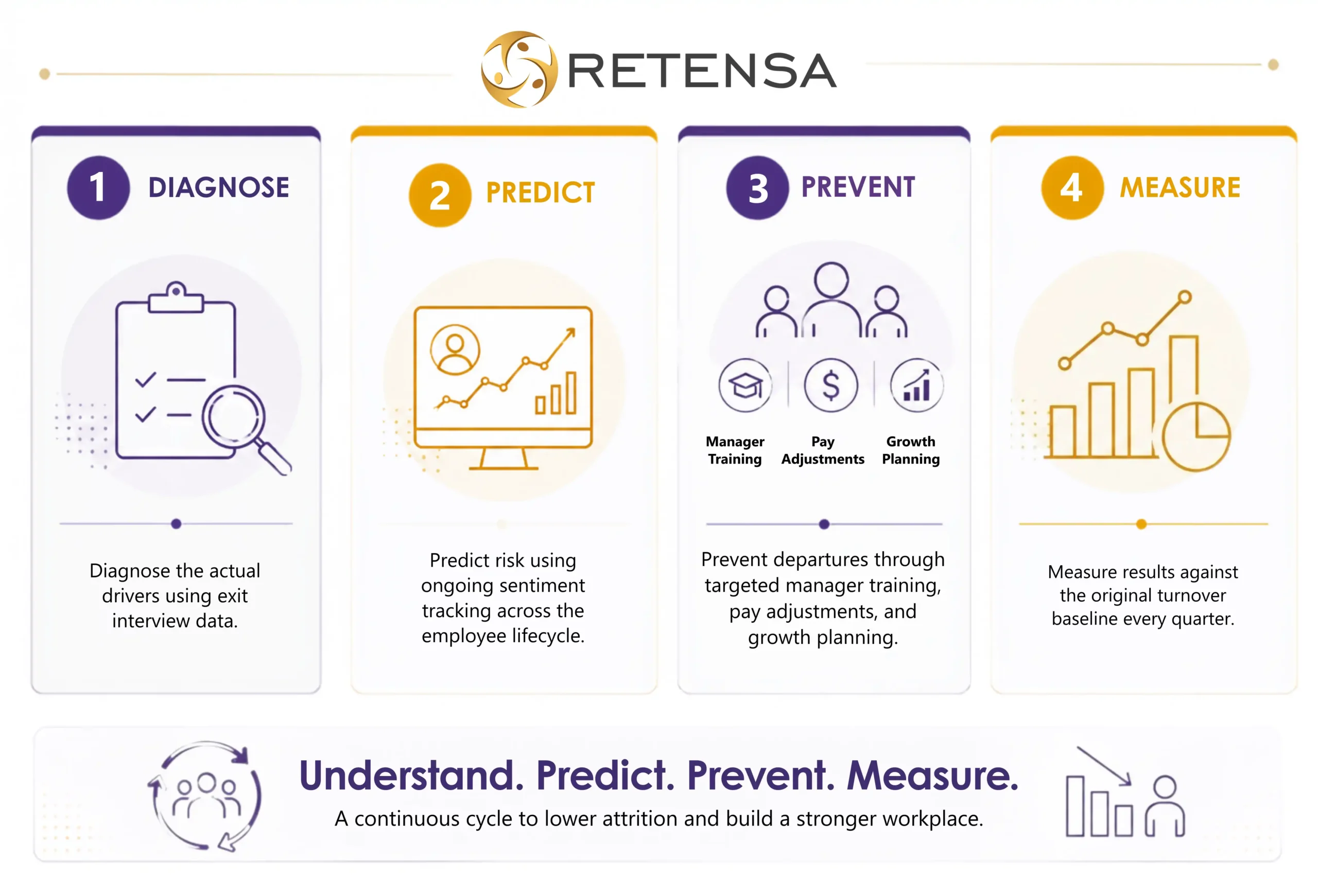
- Diagnose the actual drivers using exit interview data, not assumptions.
- Predict risk using ongoing sentiment tracking across the employee lifecycle.
- Prevent departures through targeted manager training, pay adjustments, and growth planning.
- Measure results against the original turnover baseline every quarter.
This framework turns turnover reduction efforts into a structured process with a measurable return. CFOs respond to that kind of result more readily than to sentiment alone.
How Customized Retention Plans Strengthen Workforce Engagement
Most employee retention solutions marketed to HR leaders repeat the same surface-level perk, free snacks. These do not address the underlying causes documented above.
A talent retention strategy built on diagnosis, prediction, and measurement consistently outperforms one built on assumption. It targets the drivers behind one workforce’s specific turnover, not a generic checklist borrowed from elsewhere.
Where Retensa Fits Into the Process
Most of the data in this article points to one conclusion. Turnover is rarely a mystery once an employer tracks the right signals. Retensa gives HR leaders the tools to put that measurement in place. ExitPro surfaces the real reasons behind departures, and TalentPulse tracks engagement and risk before resignations happen.
The combination gives employers an employee retention program built on evidence specific to their own workforce. That evidence comes from their own data, not a borrowed checklist from another industry. HR leaders who move from reactive exit interviews to structured employee retention solutions see measurable turnover reduction within one to two quarters.
Frequently Asked Questions
What is the most effective employee retention strategy for reducing turnover quickly?
Exit interview data combined with real-time engagement tracking pinpoints the drivers behind departures. That detail narrows the fix to a specific department or role. Targeted fixes, such as manager training or pay adjustments, produce faster results than broad perks programs.
How much does employee turnover actually cost an employer?
Replacement costs now average $45,236 per departure across U.S. employers, factoring in recruiting, onboarding, lost productivity, and team disruption. Senior and specialized roles often cost two to four times annual salary to replace.
Why does new hire turnover happen so often in the first six months?
Poor onboarding leaves new hires uncertain about expectations and disconnected from their team. A structured 30-60-90 day check-in cadence addresses this gap directly and improves early retention.
Can predictive analytics really prevent employees from quitting?
Predictive tools like TalentPulse track engagement and sentiment signals across the employee lifecycle. They flag risk before a resignation happens. This gives managers a window to address concerns while the employee is still open to staying.
How often should employers run stay interviews or engagement surveys?
Continuous or quarterly check-ins outperform annual surveys alone. Employers that use feedback tools report lower turnover than employers that check in once a year.
What should a structured employee retention program include?
A structured employee retention program combines diagnosis, prediction, and consistent measurement. It starts with exit interview data and ongoing engagement tracking. It closes the loop with manager training, pay adjustments, and growth planning. Employers check results against a defined turnover baseline every quarter.
How is a talent retention strategy different from a typical engagement program?
A typical engagement program measures sentiment in general terms, often through an annual survey. A talent retention strategy ties that sentiment data to specific departures. It then targets the exact driver behind each one, whether pay, management, or growth path.
What is a realistic timeline to see results from an employee retention program?
Early signals, such as exit interview themes and engagement score shifts, typically appear within one quarter. Measurable turnover reduction usually takes two to four quarters. The timeline depends on workforce size and how far pay and management gaps have to close.