
Infographic: Employee Wellness Survey
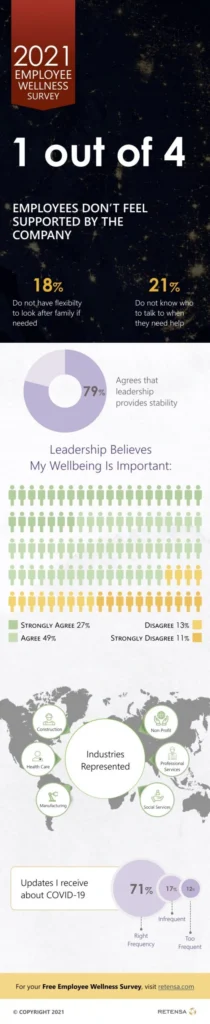
In the turmoil of the initial pandemic, employers naturally focused on resolving the major problems such as businesses closing, partnerships coming to an end, or market demand plummeting. Doing what they could to persevere, employers neglect the not-so-obvious issue…employee wellness during a crisis. Employers/Leaders/HR: Have you been able to take a step back and listen to your people (instead of the news)? Employees/Staff: Are you able to express your concerns with the company you work for? How did your organization alleviate your stress? To stay in touch with employee needs during such volatility, uncertainty and ambiguity, Retensa developed and deployed an Employee Wellness Survey at no charge to any employer. It was important to capture a candid conversation on the topic of workplace wellbeing. Organizations from all over the world embraced the tactic (and continue too). Industries ranging from manufacturing, to non-for-profits, to technology services responded. We extracted 1000+ responses to reflect a cross section of the workforce. Highlighted findings are presented in the infographic below. Are you curious about how YOUR employees feel right now? Do you believe that mental and physical health are important? If yes, go find out. NOTE: To help leadership stay connected with their workforce, especially now, we are giving all employers – of any size – free access to this Employee Mental Wellness Toolkit. All participating companies will receive advanced response data reports. (PS – You can customize the employee wellness questionnaire or use the preset 18 questions prepared by Retensa’s Survey Design team.)
The 5 Ways to Boost Employee Wellness in Stressful Times

Employee mental health now confronts every employer in every country like never before. Although its relevance increased in recent years, the current global health event forced employers to rethink the importance of understanding employees’ state of mental health and overall wellness. Right now[1], employees are experiencing significant change with perpetually elevated anxiety and stress. Extensive research indicates that happier employees increase productivity from 12% – 20%[2]. As stress increases, performance and product quality plummets. Most employers want their workforce to be happy and healthy. An unhappy and unhealthy workforce directly erodes customer service, productivity, and profit. So how can we support staff best in this time of prolonged discomfort? (Covid-19 Impact: Employee Wellness Strategy) The 5 Ways to Boost Employee Wellness in Stressful Times Ensure Flexible Work Arrangements: Last year, Retensa’s employee experience surveys indicated that one of the top reasons employees stayed at their employer was the ability to maintain work-life balance. In this era of mask wearing and social distancing, most employers that could move to remote work opportunities, did. That is represents around 30% to 35% of the US working population. For employees who already have returned, a lot of stress comes from worrying whether their workplace is safe and feeling like they have to choose between following public health recommendations or getting a paycheck. It will have long-term benefit to stay accommodating to employee personal needs. Over half of all employees are juggling children or parent care right now. On top of their jobs and their own health. Employer flexibility to manage work-life balance conveys respect and appreciation for employee wellbeing. Transparency from Leadership: One of the best (and easiest, and cheapest) tactics leaders can deploy is frequent communication with staff. Today that looks like scheduling town halls where individuals bring questions. Every company can survey their workforce on wellness for free, capturing concerns in real time to address cumulatively. If you are a front-line manager, set a reminder to check in every week with direct reports as situations change quickly. Keeping employees ‘in the know’ as company policies change will mitigate concerns and support planning. The level of uncertainly is so great in so many other areas, don’t be afraid to over-communicate. Right now, you can’t.Keep in mind that communication is a two-way street. Do employees have an outlet to express concerns and contact leaders? How are employees’ voices heard and acknowledged? When they are, people feel more secure and confident, which translates into company loyalty. Promote Connectedness (HINT: Make it Fun): Are you laughing less? Yea, EVERYONE is. A lot less than pre-pandemic. A few studies range from 50% to 80% less laughing. Before “the end times”, life stressors would bring us down, but we could turn to a friend at work for a pick-me-up. Being more isolated than we ever were, how can work reinvigorate that feeling of community and connectedness? Humans are naturally social creatures so whether we “like it” or not, staying at home all the time is not healthy. Employers can foster that feeling of connectedness by increasing engagement with internal communication boards or by encouraging video shares to highlight individuals and team building. Cooking together, workouts, even poker games are video capable. Physical health is also taking a toll by sitting down all day. Set group competitions or mini challenges to encourage activity, exercise, and interactions. Gamify to make it fun. Many no or low-cost Apps exist that create a weekly leader board. Sponsor with prizes or awards for those who did the most pushups, miles biked, or who walked the most steps. Keeping it communal enhances belonging, generates excitement, and reinforces a sense of accomplishment. This is really important right now because the intrinsic value that people received from work, relationship with colleagues, was the #1 thing people liked in their job last year. They are not getting that now. With a few programs, you can provide it. Reevaluate your Benefits NOW: What employees needed 10 years, 5 years, or even last year is not what they need today. Are you meeting the moment to provide the benefits your employees need? It’s easy to know, because you can simply ask them. Pulse the workforce, ask the questions, consult with managers to uncover what’s missing. Once you reveal the gaps, start filling them in with ways to support employees, especially outside of work. Promote valuable resources and knowledge-sharing opportunities. A lot of time employees may be aware of resources but not know where to find them or may not feel like they can actually utilize them. Many companies are offering things like hotlines for mental health support or meditation classes. Leaders can set the example, becoming allies in encouraging healthy behavior and supporting new habits. Encourage healthy habits by expanding monetary reimbursements for professional learning and development, skill enhancement or training. (Retensa did, and more people than ever are taking advantage of it). Promoting individual growth opportunities leads to personal fulfillment and improved morale. The more an employer offers to get healthy, the healthier the workforce will be. Recharge your Acknowledgments & Appreciation Awards: According to the US Department of Labor, 88% of employees stated a lack of recognition as their top work issue and it does not have to be. Celebrate accomplishments, big and small. Acknowledge both publicly and privately. This works best when it’s “baked in” to existing events, instead of an add-on. At Retensa, we have “Ms. Pro-FISH-ient”, which is a stuffed marlin we pass out to a new employee at our weekly company huddle. This person is someone who has gone out of their way to help or exemplified one of our core values. It’s a way for us to peer-recognize that’s already incorporated into our culture. Perhaps it’s a silly stuffed animal, a potential winning lottery ticket or an internal communication board called “Shout Outs and Thank Yous”. To give recognition when it comes to mind can look however you like, but whatever it is, it reminds employees that even though they are
The 3 Signs You Can’t Ignore: Employee Mental Wellness Warnings

Employee mental wellness was always a workplace concern, but never a priority. Elevated amidst the global pandemic, COVID-19 created a universal sense of uncertainty that would not subside. This is forcing employers to evaluate work-life balance like never before. Those who work from home may face additional challenges such as isolation from their friends and coworkers, increased childcare and home-schooling responsibilities, adjusting to distracted workspaces, and taking care of older and/or immunocompromised friends and family members1. These unique circumstances can amplify anxiety and stress for both employees and employers, which could result in severe mental health issues and unhealthy behavior. The 3 Warning Signs You Can’t Ignore Here are the signs to look for that may indicate that an employee is struggling with their mental wellness: Sudden Discomfort or Panic. The most overt signal of the 3 you can’t ignore can be noticed even if your workforce shifted to working from home (“WFH”). Managers can be on the lookout for direct reports exhibiting excessive nervousness, tension, difficulty breathing, a racing heartbeat, chest pains, or dizziness. A rapid urge of overwhelming anxiety and fear can overwhelm the senses in physically healthy people. Prolonged mental strain at home can be triggered by a momentary worry at work, and manifest physical symptoms. Apathy A lack of productivity and quality is not necessarily a performance management issue; it can be a mental health concern. If an employee exhibits a sudden lack of motivation or is having difficulty concentrating in meetings (virtual or onsite), it’s not always “Zoom Fatigue”. Take note if a usually prompt employee now arrives late to meetings, has an indifferent attitude towards work, or exhibits social withdrawal. If they display a significant lack of availability, call in sick more often than before, or do not turn on their video again that day, it is important to ask questions instead of brushing them off2,3. Irritability or Low Tolerance of others. Dramatic changes in an employee’s mood and social interactions can signal underlying mental health issues. While these behavioral changes are more noticeable in person, they can also be recognized over video chat. Employees can be more conscious of their colleagues displaying unusual behaviors, such as short temper, dismissal of others, or repeating negative thoughts2,3. In these cases, outward aggression is more likely, and intervention most needed. The Challenge “Everyone is stressed” “No one sleeps 8 hours” “Who isn’t irritable right now?!” Yeah we get it, a lot going on. So, changes in work style and interpersonal behavior can be difficult to notice. Easier when everyone is in on-site, harder when people WFH. Additionally, though the stigma of mental illness is slowly dissolving, many employees feel uncomfortable addressing their mental health with their employers1. Consequently, employee mental stress concerns often go unrecognized and unaddressed. But they don’t go away. Inevitably, compound stress leads to bigger problems for the employee and organization. What can Leaders do? Don’t rely on people to self-report. Encourage managers and employees to regularly check in with their direct reports and coworkers, even if they don’t see any of the poor mental wellness signs. For all the gripes, video calls make it easy and convenient to regularly check in with your direct reports and coworkers3. Two-way communication is essential to build trust and make employees feel more comfortable to discuss their mental health. It is important to ask direct questions such as: “How are you managing with the workload while working from home? Do you need any additional support with anything?”1. These check-ins can be informal. Try one at the beginning of a meeting. Or they can be more formal such as scheduled, individualized check-ins3. The point is to regularly monitor your teammates and ensure that everyone is doing well. Compassionate communication. Talking about mental wellness can be normalized. Remember when women didn’t talk about pregnancy? Or when people didn’t talk about their lactose intolerance? It’s normal now because social norms can and do change. Employees can feel comfortable discussing their struggles and feelings with their managers. Managers can act as role models for their direct reports by speaking openly about their own mental state. People feel better to express themselves when they have the safe space to discuss their emotions, without having to conceal any mental health concerns they may be experiencing3. It also helps to create awareness that significant changes in team member’s work or social interactions may be a sign that a person is overwhelmed1. By being aware of the signs to look for, managers can take the extra initiative to show compassion to their direct reports, which has a profound effect on an individual struggling. One of only FOUR universal traits of feeling cared for, specifically “loved”, occurred when “someone shows compassion toward them in difficult times”4. And we are in difficult times! Another had to do with pets, and you don’t have enough labradoodles to take that route. So be compassionate. Don’t rely on coworkers. While it is important to frequently check in with your team, it is more beneficial to collect data and measure your employees’ mental wellness confidentially (i.e. surveys). Collecting data digitally allows you to measure a greater number of employees at once and improves the reliability of the information that you collect. As opposed to relying on in-person communication, collecting wellness opinions online or by SMS text is significantly cheaper and faster. It also reduces the potential for human bias and error from the information collected. To help measure the mental wellness of your workforce, Retensa offers a free employee mental wellness survey that captures and reports on the current state of employees’ mental health. A targeted wellness survey allows you to surface the root causes of any anxiety your employees experience. It can also reveal unrecognized sources of concern among staff. Identifying the root causes of stress allows leaders to prioritize the appropriate issues. Otherwise, they (and you) are just guessing. Be transparent. The pandemic placed people in an unparalleled state of uncertainty. Many don’t know how much longer